

Personal vs Business Credit: How to Build Business Credit
Personal vs Business Credit: Core Differences
Most business owners start out using personal credit to fund their ventures. It works — until it doesn't. Personal credit ties directly to your Social Security Number and reflects your individual financial history. Business credit, by contrast, is anchored to your Employer Identification Number and your legal business entity. They are two separate financial identities, and treating them that way opens doors that personal credit alone cannot.
The bureaus that track business credit are different too. Dun & Bradstreet, Experian Business, and Equifax Business each collect trade data and publish their own scores. D&B's PAYDEX score, for example, runs from 0 to 100 and rewards early payment — paying even a few days ahead of a net-30 due date can push your score toward 80 or higher. That scoring logic differs sharply from FICO, where utilization and credit age carry heavy weight.
Why does this matter practically? Vendor terms, insurance premiums, equipment financing limits, and commercial lease approvals all hinge on business credit. A strong profile can unlock net-60 terms with suppliers, lower deposits with insurers, and six-figure credit lines — none of which are visible on your personal report.
Why Separating Personal and Business Credit Matters
Keeping these two worlds apart is not just good hygiene — it is a strategic advantage. When business debt stays off your personal report, your personal utilization stays clean and your FICO score remains intact. That matters if you ever need a mortgage, a car loan, or any personal financing.
From the business side, a standalone credit profile gives lenders and underwriters something concrete to evaluate. Banks and commercial lenders are far more comfortable extending credit to an entity with its own verified history than to an individual who happens to own a company. Approval odds improve, and so do credit limits.
The credibility effect extends beyond lenders. Suppliers, landlords, and strategic partners often run credit checks before agreeing to terms. A registered business with a documented payment history signals stability. A sole proprietor operating on personal credit signals risk. Separating the two is one of the fastest ways to elevate how your business is perceived.
How to Build Business Credit: Step-by-Step
Form and Legitimize Your Business
Before any bureau can build a file on your company, the company needs to exist in a verifiable, consistent form. Incorporate as an LLC or corporation — sole proprietorships have no legal separation from their owners, which undermines the entire goal. Secure the required local and state business licenses, then audit your Name, Address, and Phone (NAP) across every online listing: Google Business Profile, Yelp, industry directories. Inconsistent NAP data causes verification failures that can stall credit applications.
Establish Your Business Identity with the IRS and Banks
Apply for an EIN through the IRS — it takes minutes online and is free. Then open a dedicated business checking account. That account does double duty: it separates your finances cleanly, and it creates a transaction history that lenders will request when underwriting. Avoid running personal expenses through it.
Start Trade Lines That Report
This is where most business owners miss a step. Not every vendor reports payment activity to the business bureaus. You need accounts specifically with vendors that do — companies like Quill, Uline, and Grainger offer net-30 terms and report to D&B and Experian Business. Apply for three to five of these accounts, make small purchases, and pay the invoices before they are due.
A business credit card that reports to business bureaus adds another data point. Keep utilization below 30%, ideally below 15%, and pay the full balance monthly.
Pay on Time (or Early) and Scale
PAYDEX scores reward early payment specifically. Net-30 terms paid in 20 days earn more points than invoices paid exactly on day 30. Do this consistently across multiple accounts, and within six to twelve months, you will have a score that qualifies for higher-tier credit products — store cards, fleet cards, and eventually Visa or Mastercard business products underwritten on the business file alone.
How to Build Business Credit With Bad Personal Credit
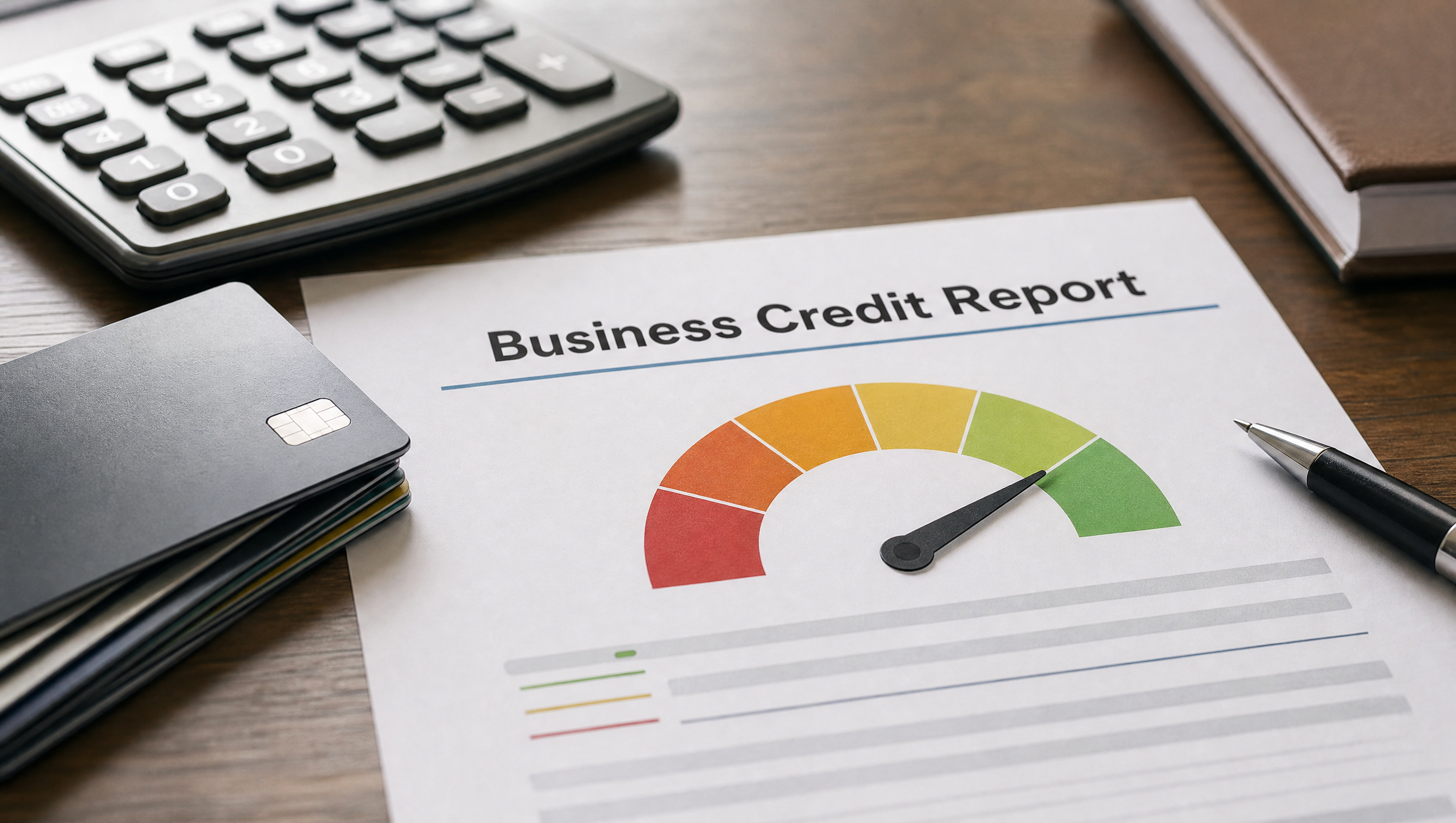
Bad personal credit does not lock you out of building business credit — it just changes the path. The question of how to build business credit with bad personal credit is one we hear often, and the honest answer is: start with products that do not require a strong personal guarantee.
Vendor accounts like those mentioned above — Quill, Uline, Crown Office Supplies — extend net-30 terms with minimal credit scrutiny. Secured business credit cards are another entry point; you fund the deposit, they report the activity, and your personal score matters less. Use your EIN on applications wherever the lender allows it, which minimizes hard pulls on your personal report.
If a lender does request personal information, you can compensate for a weak personal score by demonstrating cash flow. Three to six months of business bank statements showing consistent deposits is tangible evidence that the business can service debt. Offering a deposit or collateral also shifts the lender's risk calculus.
The progression is deliberate: vendor credit first, then store and fleet cards, then general-purpose business cards. Each tier builds the history needed to access the next. Skipping steps wastes time and generates unnecessary denials. On this path, how to get credit with bad personal credit becomes less about fixing the past and more about building a parallel, stronger record.
How Do I Use My EIN to Get Credit?
"How do I use my EIN to get credit?" is a reasonable question and a practical goal. Some lenders and vendors underwrite solely on the business entity — no personal guarantee required. Reaching that point takes groundwork.
Start by ensuring your business information is consistent everywhere: legal entity name, registered address, and business phone must match exactly across the IRS EIN letter, your Secretary of State filing, and any application you submit. A mismatch between your Articles of Organization and your application triggers a verification denial before anyone reviews your creditworthiness.
Create and claim your D-U-N-S number through Dun & Bradstreet if you do not already have one — it is free and required for many vendor relationships. Then confirm that your trade accounts are actually reporting; log into D&B's CreditSignal or Nav to verify. Accounts that do not report are invisible.
The document stack matters too. Keep these ready: your IRS EIN confirmation letter, Articles of Organization, business license, and at least three months of business bank statements. Lenders that accept EIN-only applications will still want proof the entity is real and active. With that package prepared and a few reporting trade lines established, you have a genuine answer to how to get credit for my business — one that does not require strong personal credit as a crutch.
Monitoring, Optimization, and Common Mistakes
Building business credit is ongoing work, not a one-time setup. Monitor your profiles on D&B, Experian Business, and Equifax Business regularly — at least quarterly. Errors appear more often than they should, and disputing them promptly prevents inaccurate data from dragging down your scores.
The most common mistakes are predictable. Mixing personal and business expenses muddies both records and undermines the separation you worked to create. Applying to too many lenders in a short window generates hard inquiries and signals desperation, which damages approval odds. And neglecting utilization — carrying high balances on business cards — suppresses scores even when payments are on time.
Tier your applications. Start small, establish a track record, then apply for more. Keep utilization consistently low, pay early where the scoring model rewards it, and let the file age. At Haze Tech Solutions, we work with clients across industries who are scaling their operations and their credit simultaneously. The businesses that do it systematically — entity first, trade lines second, monitoring throughout — are the ones that access capital on their terms, not the lender's.