

Small Business Loans: Financing Options for Small Companies
What Are Small Business Loans? Funding Basics and Use Cases
Why Financing Matters
Revenue alone rarely covers everything a growing business needs. Equipment wears out, opportunities arise faster than cash accumulates, and seasonal swings can leave even profitable companies short on working capital. A small business financing loan fills those gaps — not as a crutch, but as a deliberate tool that keeps operations running and growth on schedule.
Common Use Cases
The most common reasons businesses borrow are also the most practical: purchasing equipment, hiring ahead of a busy season, opening a second location, or bridging the 30-to-90-day window between invoicing a client and getting paid. Small business funding complements what you already earn; it doesn't replace sound financial management. The key is choosing loan terms — amount, rate, and repayment schedule — that match your actual ability to pay back, not just your optimistic projections.
Loan Types: Matching Products to Business Needs
Core Loan Categories
Not every loan product suits every situation. Understanding the differences saves time and money.
Term loans deliver a lump sum repaid over a fixed schedule — monthly payments, predictable interest, clear end date. They work well for defined purchases like a piece of machinery or a renovation with a known price tag.
SBA loans, particularly the 7(a) and 504 programs, are the gold standard for many small companies. Government backing allows lenders to offer lower rates and longer repayment windows than conventional products. The trade-off is paperwork and a longer approval timeline — sometimes weeks.
Lines of credit operate more like a credit card. You draw what you need, repay it, and draw again. That flexibility makes them ideal for ongoing working capital needs rather than one-time purchases.
Equipment financing and invoice factoring are asset-based. Equipment loans use the machine itself as collateral, which can preserve cash you'd otherwise tie up in a down payment. Invoice factoring converts unpaid receivables into immediate cash — useful when clients pay slowly but your bills don't.
Microloans, often offered through a small lending business or a Community Development Financial Institution (CDFI), typically top out around $50,000 and target very small or early-stage companies that can't yet qualify for traditional products.
When to Choose Each
Match the loan to the purpose. A line of credit for a one-time equipment purchase means paying revolving interest on a depreciating asset — inefficient. A term loan for unpredictable working capital needs can create cash-flow strain when revenue dips. Clarity on your purpose narrows the field quickly.
Startup and New Business Financing Options
Pre-Revenue Options
Getting funded before you have a track record is harder, but not impossible. Startup business loans often rely on the owner's personal credit score, a formal business plan, and sometimes collateral — real estate, equipment, or savings. SBA microloans are a common entry point because they're designed for early-stage borrowers and come with technical assistance that larger banks don't offer.
Early-Stage Growth Capital
Business loans for new businesses are frequently packaged alongside other funding sources. Grants from local economic development agencies, crowdfunding campaigns, and revenue-based financing — where repayment scales with monthly sales — can all reduce how much debt a startup actually needs to carry. Small business loans for startups that combine these sources tend to be more sustainable than a single large loan taken on before the business model is proven.
One product worth approaching carefully is the merchant cash advance. It delivers capital fast, but the effective cost can exceed 50% APR when calculated honestly. Use it only when the ROI on the capital clearly outpaces the cost — and when you've exhausted lower-cost options.
Funding for Women and Underserved Founders
Targeted Programs
Small business funding for women has expanded significantly over the past decade. Beyond general loan programs, women-owned businesses can access dedicated grants through organizations like the Amber Grant Foundation, accelerator capital from programs like SBA's WOSB Federal Contracting Program, and lenders who actively target underserved founders with flexible underwriting criteria.
Obtaining a Women-Owned Small Business (WOSB) certification opens additional doors — supplier financing arrangements, federal contracting set-asides, and priority consideration from certain lenders. It takes time to certify, but the downstream benefits often justify the effort.
How to Prepare
Community lenders and CDFIs frequently work with founders who don't fit the conventional borrower profile. A small lending business rooted in the local community may evaluate character, market knowledge, and business plan quality alongside the numbers — a more holistic approach than a large bank's automated underwriting. To access small business funding efficiently through any of these channels, arrive with a concise executive summary, 12 months of bank statements, and realistic financial projections. Lenders respond to preparation.
Qualifying and Applying: Eligibility, Documents, and Costs
What Lenders Evaluate
Every lender runs through a similar checklist: personal and business credit scores, time in business (most conventional lenders want at least two years), annual revenue, debt service coverage ratio, and available collateral. Online lenders tend to weight recent bank statement data heavily; traditional banks lean on tax returns and audited financials.
A debt service coverage ratio below 1.25 — meaning you earn $1.25 for every dollar of debt obligation — will raise flags at most institutions. Knowing your number before you apply lets you either wait until it improves or explain the context proactively.
Application Checklist
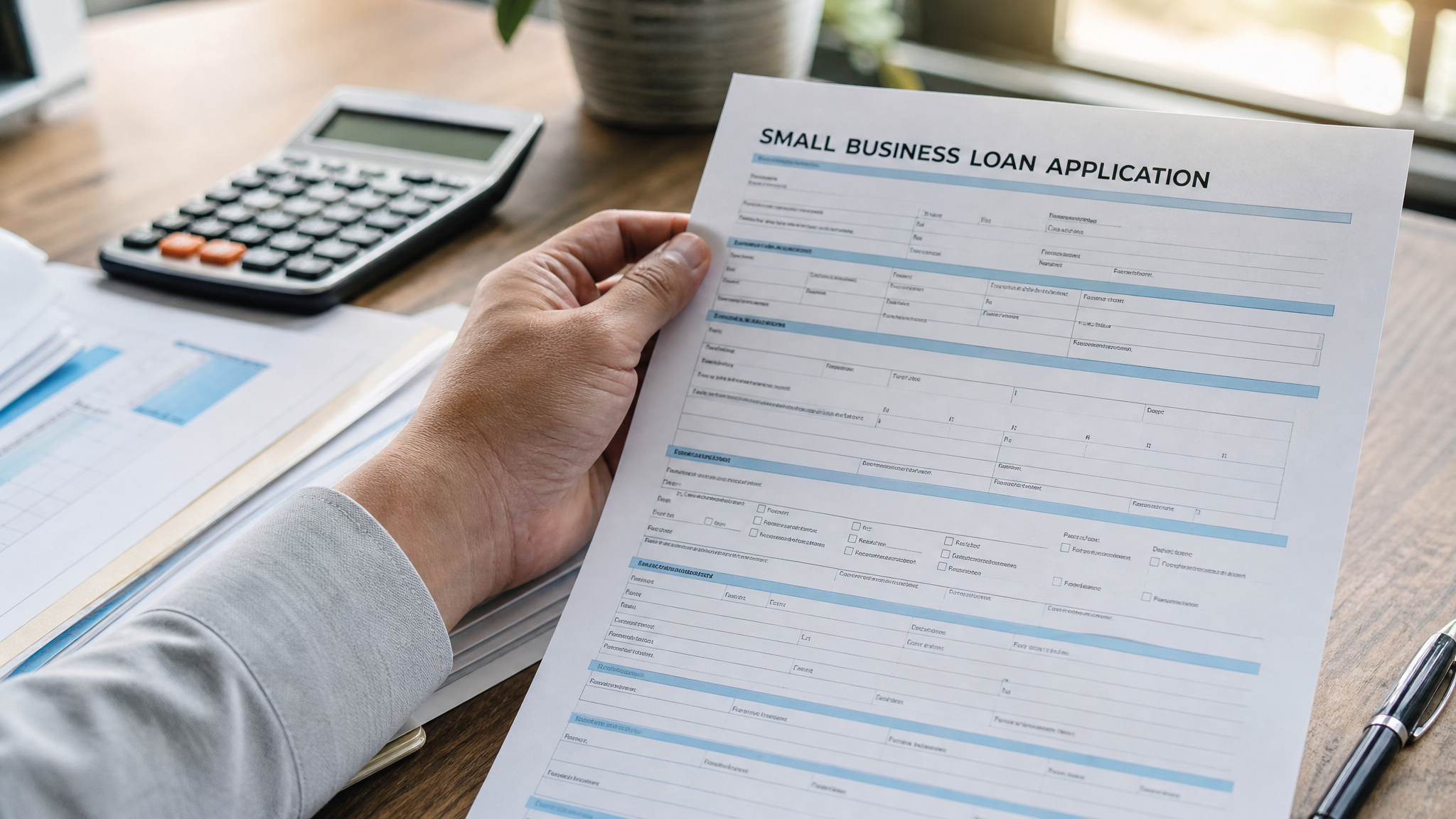
Gather these before you start any application: the last two years of business and personal tax returns, three to six months of business bank statements, a current profit-and-loss statement and balance sheet, a business plan or executive summary, and ownership and formation documents. Having this ready cuts application time dramatically and signals to lenders that you run an organized operation.
On costs, look beyond the interest rate. Compare APR, origination fees, prepayment penalties, and total repayment amounts across offers. Two loans with the same stated rate can have meaningfully different true costs depending on fee structures.
Choosing a Lender: Banks vs. Online vs. Small Lending Businesses
Where to Apply
Banks offer the lowest rates on small business loans — if you qualify. Strong credit, two-plus years in business, and solid revenues are typically required. The process is thorough and can take several weeks, but the savings on interest over a multi-year term are real.
Online lenders approve faster, sometimes within 24 hours, and their underwriting accommodates thinner credit files and shorter operating histories. That speed and flexibility come at a price — rates are generally higher than bank products, sometimes significantly.
A community-focused small lending business or CDFI sits between those extremes. Approval decisions often involve a human review rather than a pure algorithm, which benefits borrowers with complicated situations or nontraditional revenue streams. Many CDFIs also provide business coaching alongside capital, which can be worth as much as the loan itself for an early-stage company.
Speed vs. Cost Trade-Offs
Urgency matters. If you need capital in 48 hours to capture a time-sensitive inventory deal, an online lender may be the only realistic option. If you're planning a location expansion six months out, the time investment for an SBA loan will likely pay back in lower interest costs over the life of the loan. Match the lender to your timeline and credit profile, not just the loan amount.
Compare Offers and Take Action
Decision Framework
Collect at least three quotes before committing. Put them side by side: effective APR, total repayment amount, monthly payment, term length, and any fees. Align term length with the useful life of what you're financing — a five-year loan for a piece of equipment that lasts ten years makes sense; a five-year loan for a marketing campaign does not.
Next Steps
Before signing, negotiate. Origination fees are sometimes reduced for strong borrowers. Collateral release terms, prepayment clauses, and financial covenants can all be adjusted. Lenders expect some back-and-forth, and the worst outcome of asking is a polite no.
Prepare your documentation package now — don't wait until you're in a cash crunch. Businesses that apply from a position of stability, with clean financials and a clear purpose for the capital, consistently secure better terms. Small business funding on favorable terms is available; getting there requires showing up ready.